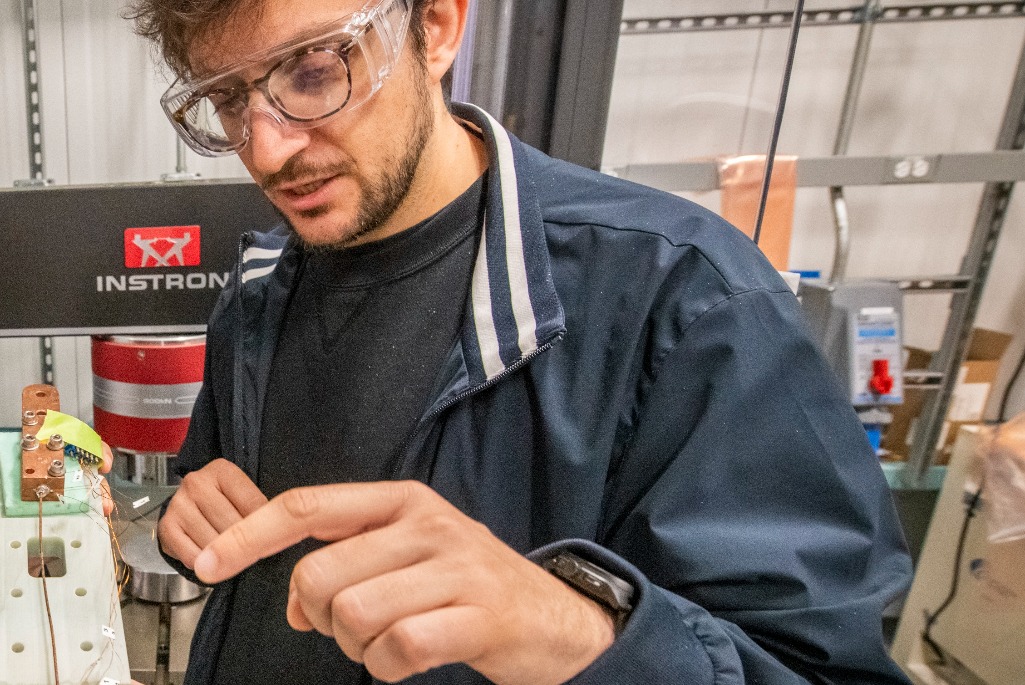
Giorgio Vallone is a member of the Berkeley Center for Magnet Technology (BCMT), a joint venture between the Accelerator Technology & Applied Physics (ATAP) and Engineering Divisions, and a research scientist in the Engineering Division, with a focus on particle detectors and superconducting magnets. Vallone is the principal investigator (PI) on a Genesis Mission project, along with Co-PI Paolo Ferracin, senior scientist and deputy of the Superconducting Magnet Program, ATAP Division at Berkeley Lab. Their project will use AI to make digital twins—virtual copies using real-time data—for fusion magnets. These magnets show great potential for enabling fusion energy but that are currently limited by the difficulty of detecting defects and preventing failure.
Vallone is an engineer by training, receiving his master’s in mechanical engineering and his Ph.D. in aerospace engineering, studying damage caused to helicopters by harsh landings. A love of physics led him to a postdoc position at CERN where he contributed to the development of superconducting magnets for the High Luminosity Large Hadron Collider project. At CERN, Vallone met Eric Anderssen, Composites and Detectors Group Leader in the Mechanical Engineering Department. This is how Vallone came to work at Berkeley Lab, joining the Engineering Division in 2018 to work primarily on particle detectors and superconducting magnets.
In this Q&A, Vallone talks about his Genesis project and his work at Berkeley Lab.
EG news:
What do you find interesting about your work in the Engineering Division?
Vallone:
I like trying to understand things. I like the challenge of doing something difficult. But most of all, I like the idea that the final objective of what I do is about pushing human knowledge forward. It feels like a good purpose.
Then, there is also the part where you are right in front of your computer, or in front of an experiment, or talking with your colleagues, and you are just trying to figure it out, and using your brain like that is just satisfying. I think this is a very common thing for people who do technical work. It can be really fulfilling to do something that you kind of know how to do, but not completely.
Additionally, much of my work has been part of national and international collaborations, and that is also an aspect that I really like. That you collaborate with the world towards a common objective, which is understanding physics.
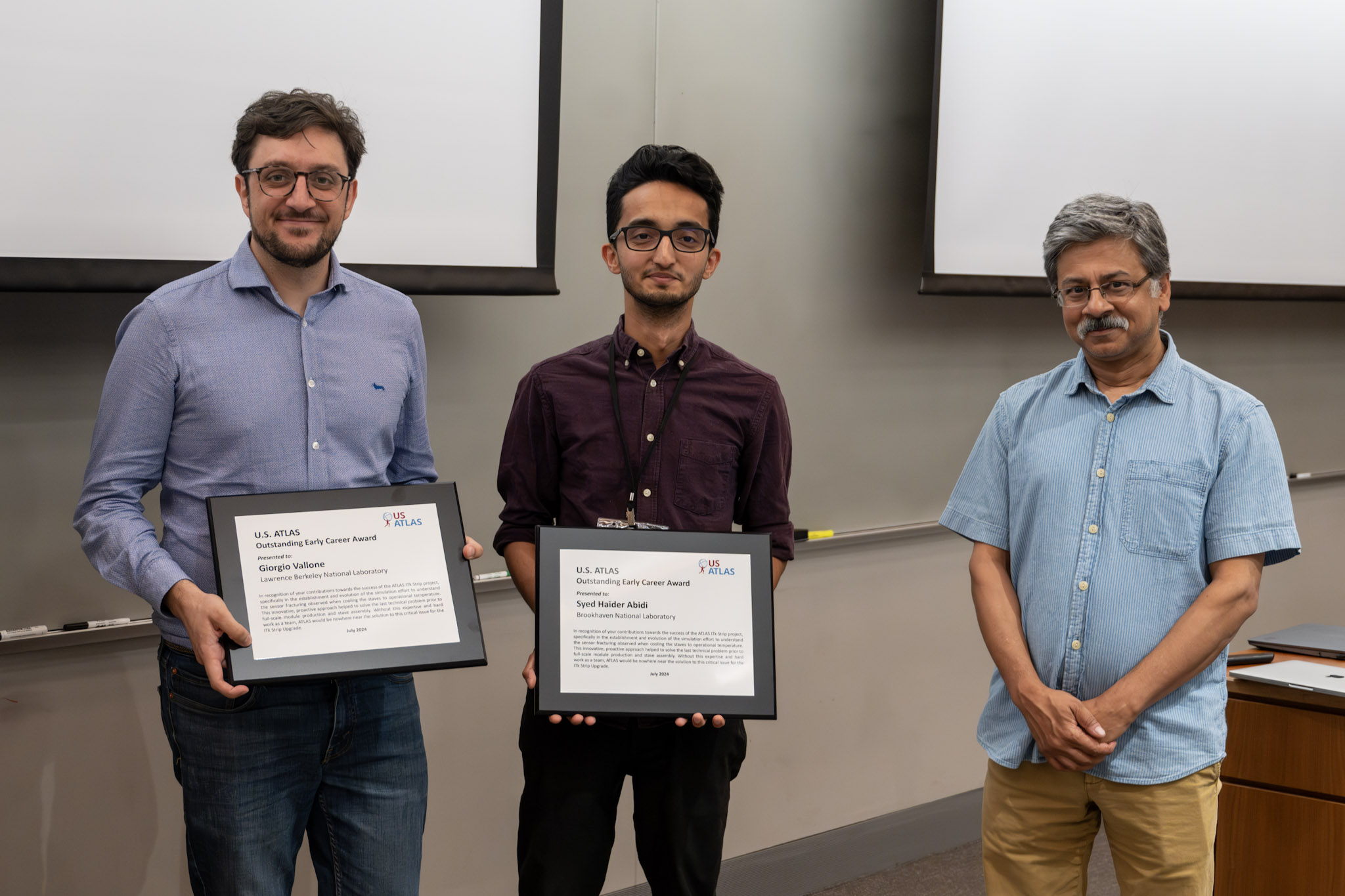
Vallone (left), pictured with Haider Abidi (center), scientist, Brookhaven National Lab, and Srini Rajagopalan (right), manager for ATLAS operations, Brookhaven National Lab. Vallone and Abidi received an outstanding early career award for their work on ATLAS.
EG news:
Can you tell me a little bit about your Genesis project and the work you’ll be doing? What do you hope to achieve and why is it important?
Vallone:
This Genesis project is focused on fusion, and in particular magnetic confinement fusion, which is currently one of the most promising approaches. It relies on large, high-field magnets, which, as you might guess, can be complicated to build and operate. In particular, we are trying to use high-temperature superconductors, which are very powerful, but also a bit unpredictable. Our current inability to understand what is really happening inside the magnets has led to many failures in the past. So, the idea is to try to prevent this by having a smart tool, an artificial intelligence, that understands what is happening inside the magnet, for example, how the current is flowing, based on the limited data that we can collect with our sensors. If successful, it should be able to tell you, “Hey, you need to ramp down the current or you’re going to burn the magnet,” or even just help you gain a better understanding of what is happening, so that this knowledge can help us improve magnets in the future.
One key ingredient for this is these new methodologies that can produce very fast numerical models of physical phenomena. These models are useful in two ways. One is that you might be able to run them in real time, integrating their prediction with sensor signals, informing decisions that can protect the magnet. And the other application is that you could imagine combining some of these algorithms to build a larger and more accurate model of your experiments, allowing you to better understand the underlying physics.
EG news:
This Genesis project is a partnership between Engineering and Accelerator Technology and Applied Physics (ATAP) Divisions at Berkeley Lab through the BCMT. What are the strengths that these two groups bring together, and why is it important to have both the ATAP and Engineering Divisions involved in this project?
Vallone:
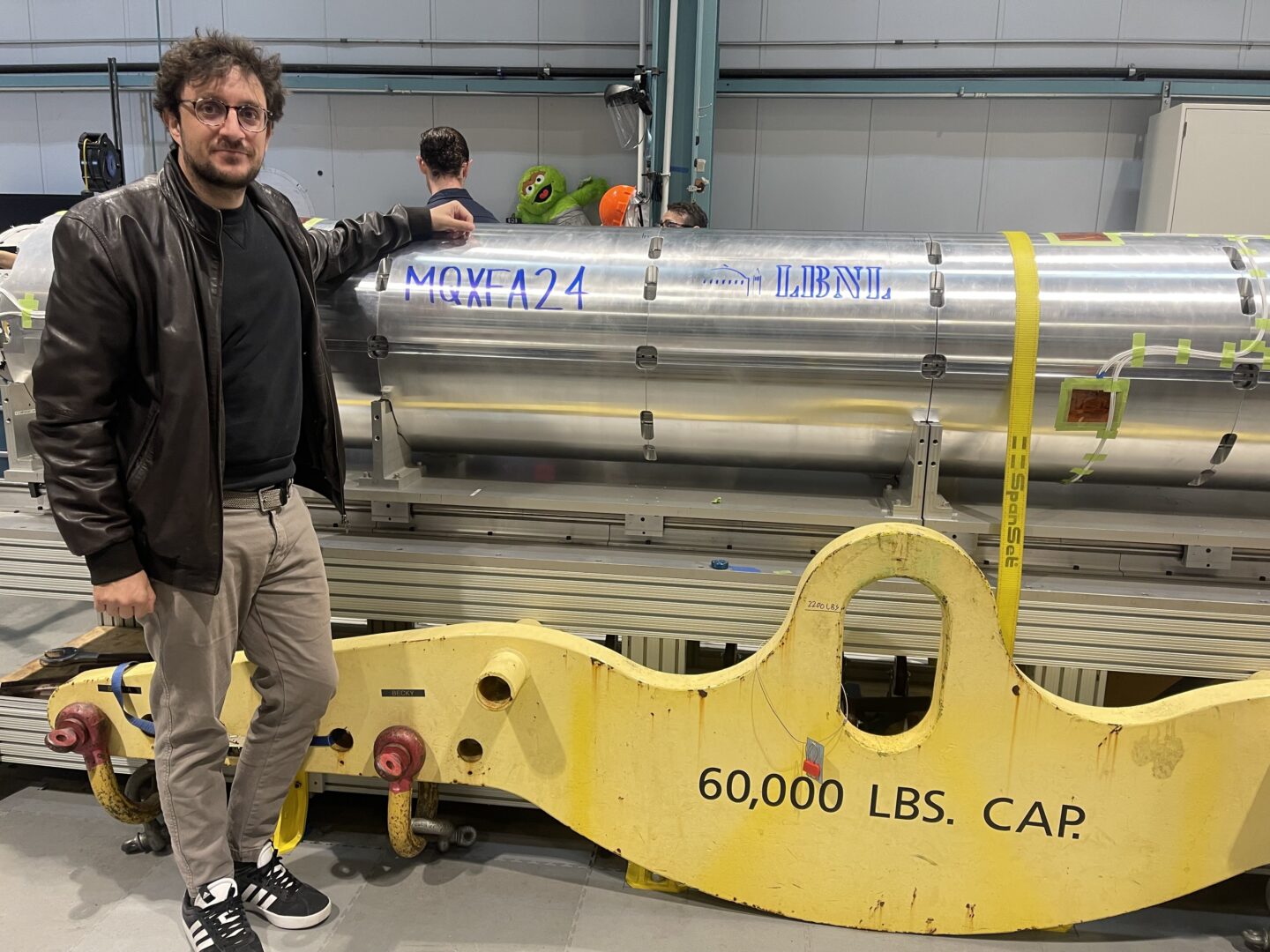
For this project, we have so many different challenges, due to the multidisciplinary nature of magnets. They are a very complex object, whose functional behavior depends on magnetics, mechanics, thermal, and superconducting physics. Putting Engineering and ATAP together is definitely making something that is way bigger than what we could do alone, bringing together people that have different expertise. It’s one of the aspects that I like most about the Lab—this ability to work together—and the fact that people here are always very open to collaborate. As my supervisor usually says, this is one of the few places in the world where if you have a question, there is likely a world expert down the corridor that will know the answer and be happy to help you. I feel very lucky being here.
EG news:
For those who don’t work in your field, what is one thing that it might surprise them to know?
Vallone:
One thing that I think surprises people is how important mechanics is for superconducting magnets. When students visit the Lab, they are amazed to see the large machinery and the many mechanical details needed to build these things. A mechanical engineer like me can be really useful!
