
The LUX-ZEPLIN (LZ) experiment recently made news with data that hints at the existence of weakly interacting massive particles (WIMPs), hypothetical subatomic particles that may help explain dark matter. This exciting revelation—a single particle interaction recorded by LZ—is the result of an international collaboration of 250 scientists and engineers from 39 institutions, including Berkeley Lab’s Physics and Engineering Divisions. Behind the data sits a partnership between science and engineering, as well as years of effort between collaborators to bring the LZ detector from theory to concept to physical reality.
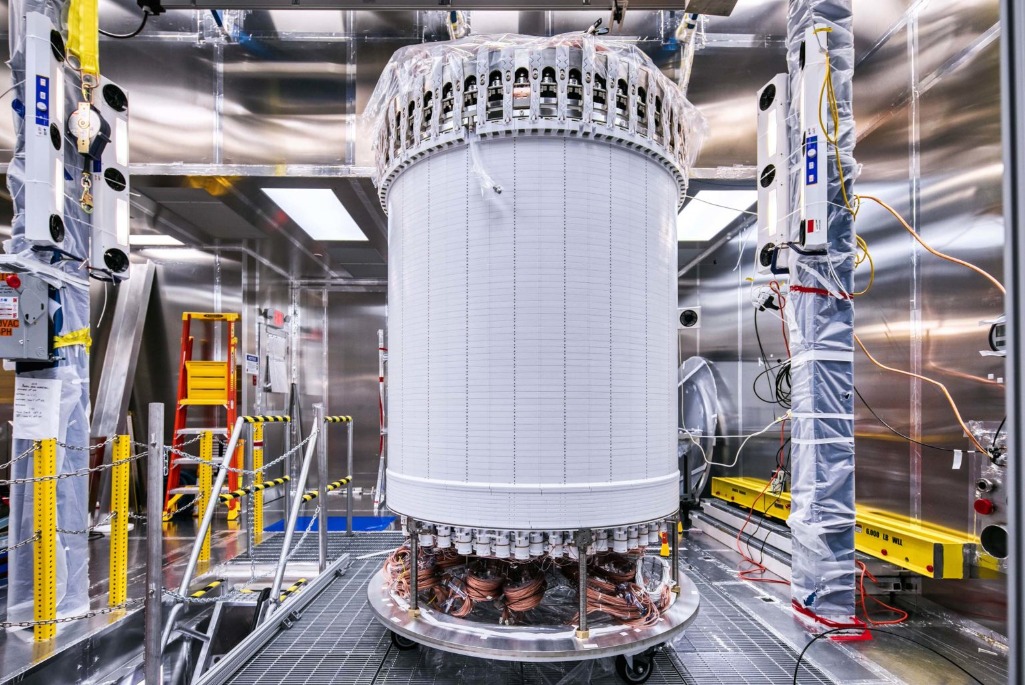
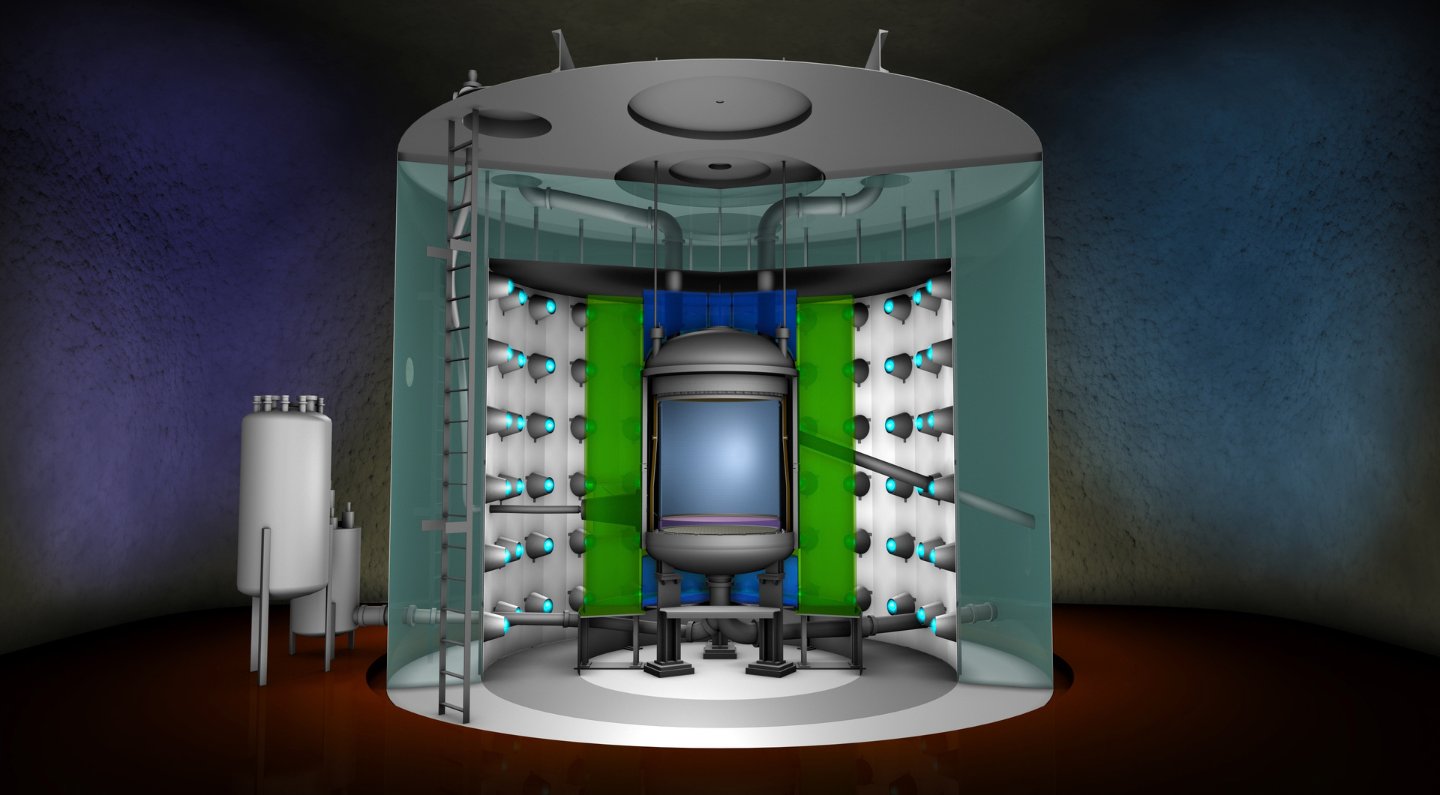
LZ is located nearly a mile underground in the Davis Cavern at the Sanford Underground Research Facility in South Dakota. It is surrounded by a water tank and a buffer layer of liquid xenon to minimize background radiation as much as possible. At the heart of the experiment, nestled within the cryostat, is the time projection chamber (TPC), a cylindrical structure that contains 7 tons of liquid xenon. Arrays of photomultiplier tubes sit at the top and bottom of the cylinder, ready to observe vacuum ultraviolet (VUV) light produced when particles interact with the xenon. The Engineering Division, guided by Will Waldron, LZ deputy chief engineer, and Joe Saba, mechanical engineer (retired), led the design and integration of the TPC’s field cage, the structure that shapes and controls the electric field within the liquid xenon.
“The field cage was an interesting collaboration between physicists, mechanical engineers, and electrical engineers,” explains Waldron. “It had to be made of low-background materials like PTFE, which is also a very efficient VUV-reflecting material, and pure titanium, and be made to gracefully expand and contract between room temperature and liquid-xenon temperatures.”
High voltage is required to produce the electrical field that pulls electrons up toward the extraction region where their signal is amplified. However, bringing high voltage from an external source through the cryostat wall to the detector’s cathode grid was difficult due to LZ’s space constraints, cryogenic environment, and radiopurity requirements. Solving the challenge of the cathode feedthrough system was spearheaded by Dan McKinsey, faculty senior physicist, Physics Division, along with his team and with the support of the Engineering Division. Adding to the engineering difficulties, interactions between detector components in liquid xenon under high electric fields were not well understood. Multiple rounds of testing were performed at SLAC to qualify the high voltage designs used in LZ.
The Engineering Division team, along with the wider collaboration, took extensive measures to ensure that every material used in the TPC field cage was low background in order to reduce the chance of radioactive materials creating false signals in the data.
As a result, relatively straightforward engineering tasks became major challenges. For example, to source voltage-grading resistors for the TPC field cage that met the project’s stringent low-background requirements, the team worked with a vendor to create custom resistors for LZ based on a commercially available thick film resistor on a ceramic substrate material. Waldron notes that while these components met the requirements for LZ, they will not meet increasingly stringent low background requirements for future experiments. Low background resistors remain an engineering challenge for future detectors that include a field cage in their design.
In addition to these considerations, all of the components of the detector had to be extremely clean—even a speck of dust can carry enough radioactive contamination to impact the experiment.
“We had to work with collaborators to make sure that their processes for machining all of these materials, such as PTFE and titanium, weren’t contaminating them,” says Kelly Hanzel, LZ project manager, Engineering Division. “Then we had to go through and have them professionally cleaned. And even after professional cleaning, we had a team in a low-radon clean room looking under a UV light and taking off dust particles.”
The Engineering Division was also responsible for the integrated 3D CAD model of the detector. This work was completed by Matt Hoff, mechanical engineering associate, Engineering Division (retired).
“This was a key role for the project because of the many collaborators who were responsible for different parts of the system,” says Waldron. “Matt designed many of the mechanical interfaces and resolved many mechanical integration issues. That was a major responsibility—to be the one who figured out how all these pieces are really going to fit together.”
In addition, the Engineering Division supported the project management effort, which includes the project’s scope, budget, and schedule. Hanzel joined the effort in 2015 as deputy project manager under Bill Edwards before taking over as project manager after LZ’s Critical Decision (CD)-2 review. On top of that, Hanzel served as quality assurance (QA) manager for LZ, authoring the project QA plan and helping collaborating institutions understand and comply with Department of Energy quality assurance and quality control rules.
“With support from control account managers and personnel from the Engineering Division’s Project Controls Group, I oversaw the implementation and maintenance of the LZ project schedule, ensuring its accuracy, EVMS compliance, and resolving issues that threatened schedule performance,” Hanzel explains. “Since LZ involved many technically challenging activities, maintaining the schedule was a constant effort that required extensive interaction with technical leads and significant problem solving.”
The Engineering Division’s role in LZ concluded when the detector was installed, though team members remain invested in seeing the results of their work. Berkeley Lab’s Physics Division continues to play a central role in the project, leading operations and analyzing data.
“When you see a potential result—like what they have found in this latest data—you feel like you’re part of something bigger,” Hanzel remarks. “It was a true group effort; I worked with a lot of really smart people on very technically challenging problems. Seeing the LZ experiment run successfully, and something come out of that in the end, really makes that whole process feel more rewarding and shows what can happen when engineers and scientists collaborate on a shared scientific pursuit.”
