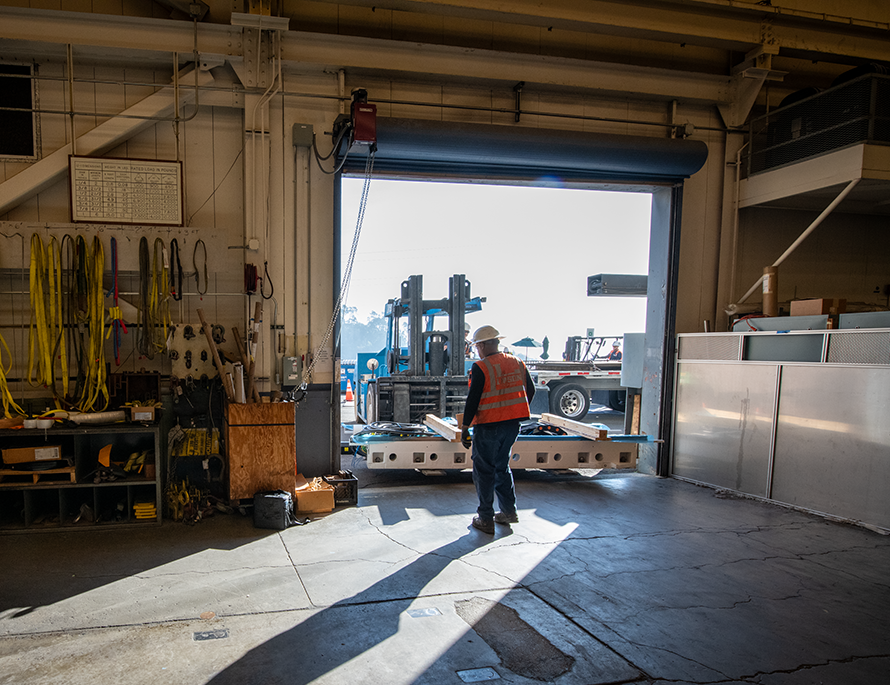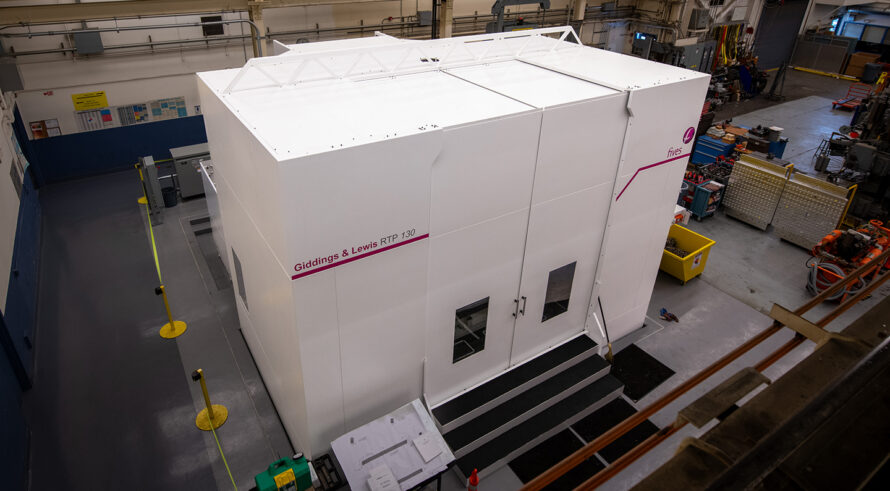
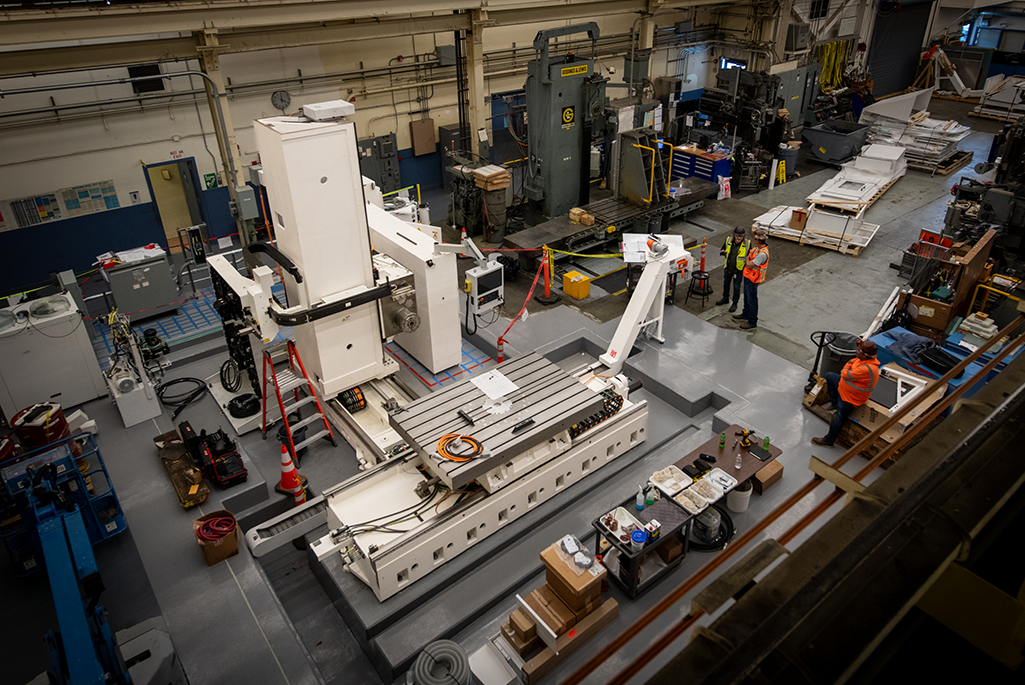
In early December, a behemoth arrived at Berkeley Lab—the Engineering Division’s new computer numerical control (CNC) horizontal boring mill (HBM). This beast of a machine will provide new capabilities to the machine shop in Building 77, performing multi-axis contour milling, precision boring, drilling, and tapping.
“Our new HBM fills an important gap in our machine shop capabilities and allows us to relieve some of the pressure on the G&L machine, which has been, until now, our largest milling center. The G&L has been a workhorse during its 44 years in operation at the Lab,” says Daniela Leitner, Berkeley Lab’s Engineering Division Director and the Laboratory’s Chief Engineer. Building 77’s large-format Giddings & Lewis (G&L) CNC machine was purchased by the Lab in 1982.
“The new CNC’s larger tables give us the ability to fabricate larger items at quicker speeds, right here on the Lab’s campus,” Leitner continues.” We are grateful to the Laboratory for supporting the acquisition and installation of this new work center.”
Planning and preparation for this new machine began in 2022, involving collaboration between the Engineering Division and the Lab’s Project Infrastructure Modernization Department (PIMD). A particular challenge of installing the HBM is that it needed to be folded into the existing shop infrastructure—no mean feat for a piece of equipment that has a large footprint and weighs in at about 80,000 pounds when fully kitted out with all of its accessories.
A special pad had to be constructed to accommodate the machine. The HBM sits on an isolated foundation that acts as a standalone base and spreads the weight of the machine over a large area to provide stability. The foundation is a 48-foot-long concrete slab, cushioned on all sides with 12 inches of sand, along with specialized isolation material. The foundation also provides the ability to anchor the machine in accordance with seismic standards.
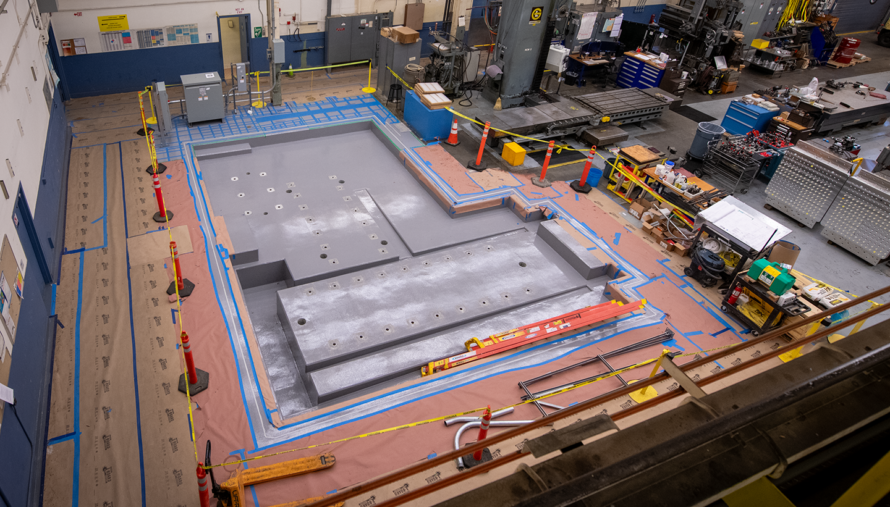
“This foundation design, once the machine is anchored, is independent from the building infrastructure and allows the machine to maintain stability and accuracy regardless of the surrounding environment, vibration, or movement,” explains Rick Kraft, a technical manager in the Engineering Division.
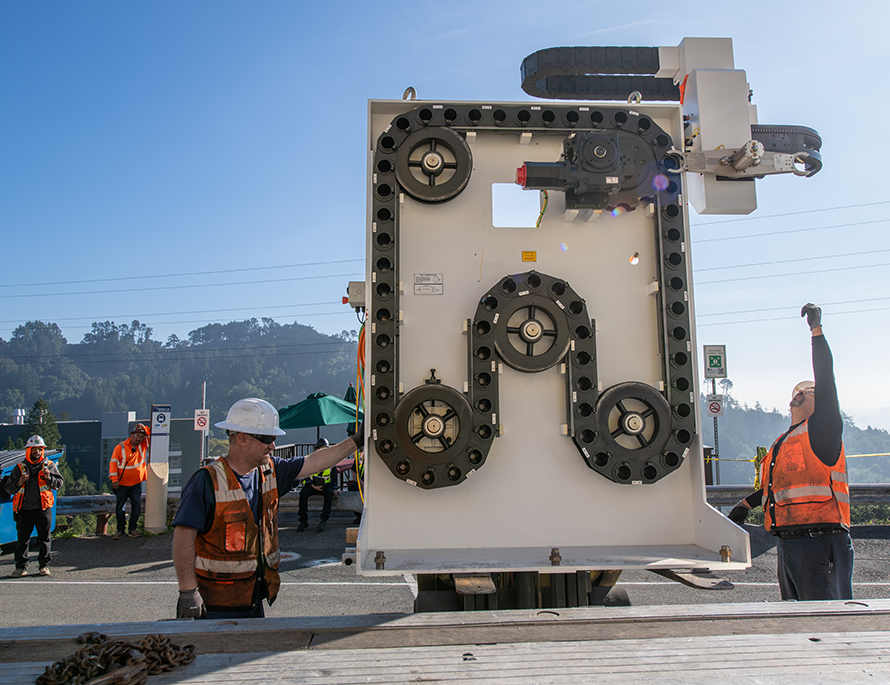
The machine was delivered to the Lab over a five-day period in early December 2025. It arrived in several pieces, some weighing up to 30,000 pounds. During the installation, riggers from the Facilities Division were on hand to support the project, using the Building 77 crane to move some of the components.
The HBM was first powered on in mid-December. The machine tool was then aligned by the manufacturer, and operator training took place in February.
“The most challenging aspect of this process is placing such a large piece of equipment in an active facility while keeping our current operations running,” Kraft says.
The new machine gives a big boost to the capabilities in the Engineering Division’s shops. Its 1250 x 1400 mm built-in contouring rotary table can accommodate much larger parts, with a side-to-side range of about 10 feet, an up-and-down range of about 8 feet, a front-to-back range of about 5 feet with rotational capabilities, and a 10,000-kg (22,000-lb) table load capacity. The HBM has a 130-mm-diameter spindle, with a faster spindle speed reaching up to 3,500 revolutions per minute. This allows for quicker cutting and smoother finishes.