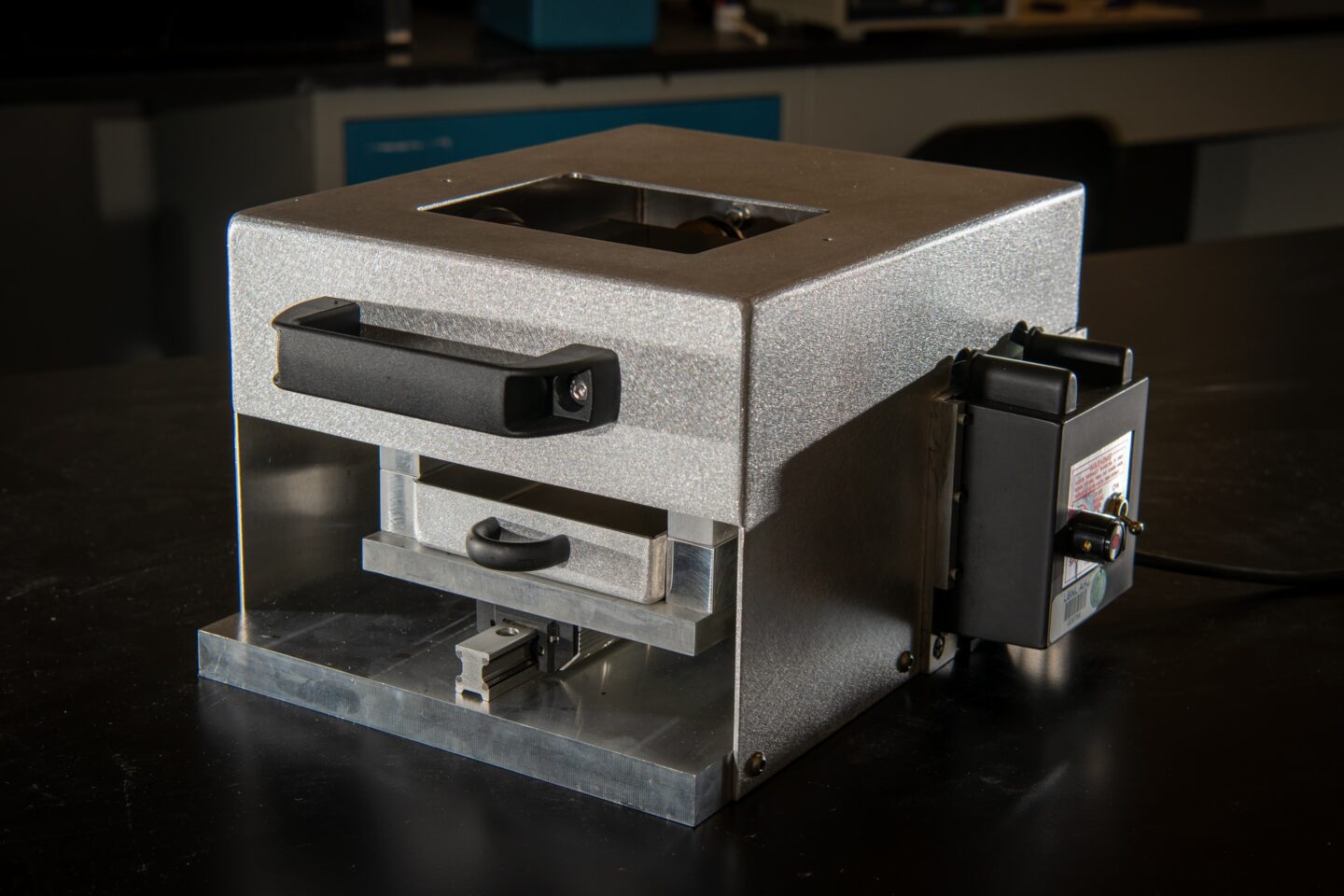
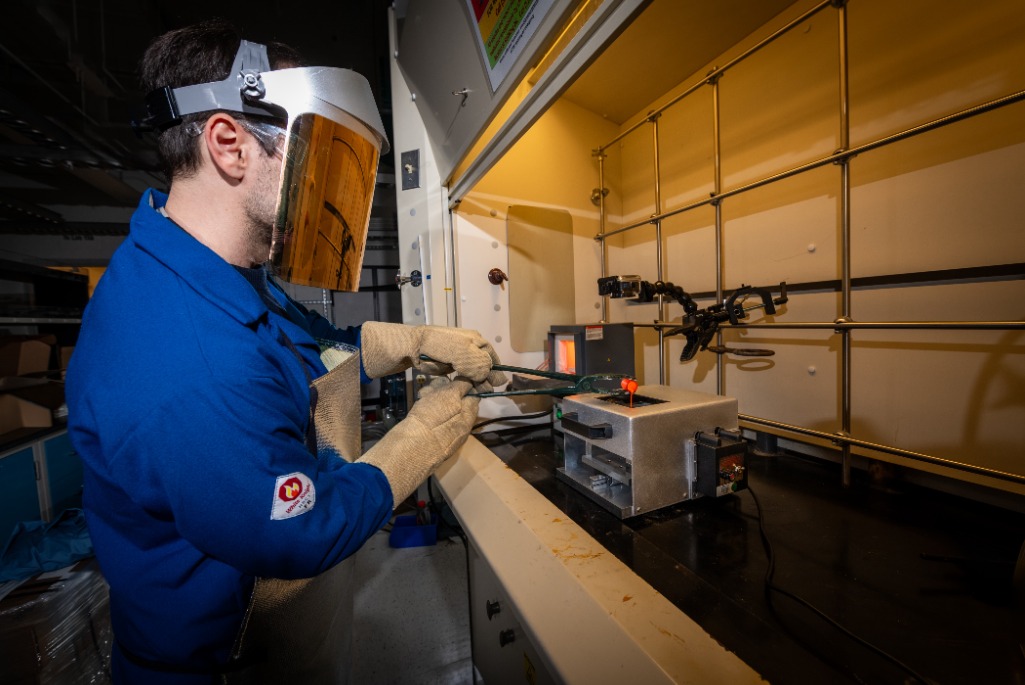
How can a device that resembles a pasta roller on steroids help scientists discover material that could advance battery technology? Welcome to the world of Engineering Small Projects Support (ESPS), where any given day can drop you into a new area of research and present unexpected engineering challenges. In this particular case, Andrew Dopilka, a research scientist in Berkeley Lab’s Energy Technologies and Systems Division, needed to quickly cool molten material for battery research that is part of an Early Career Lab Directed Research and Development (LDRD) funding award. With some ideas on how to do this, but no practical way to implement them, he turned to ESPS for an engineering boost.
“I’m trying to discover, essentially, new glass materials or amorphous materials that could have beneficial properties for lithium-ion batteries or other types of energy storage,” Dopilka explains. “Lithium-ion battery electrodes like to host lithium ions. So, lithium goes into them, lithium goes out, and the path the ions take is very important to their operation and reversibility. In amorphous material, since the paths are more disordered and random, there’s actually less stress upon charge and discharge, which could potentially lead to longer-lasting batteries.”
In a lab environment, these amorphous materials are made by quickly cooling molten substances, solidifying them before crystals form, ensuring that the solid material has the desired amorphous—that is, non-crystalline—structure.
Dopilka had seen a device in older literature that allowed researchers to pour a drop of liquid between two metal rollers that were spinning very quickly. He believed this might be the answer to his problem.
“If you squish the molten liquid with a lot of pressure, you decrease the thermal distance it needs to cool, and you can get to around 10 to the sixth kelvin per second cooling rate,” says Dopilka. “That really opens up the possibility for quenching a lot of unusual materials that can’t typically be formed with conventional melt quenching techniques.”
ESPS on the Case
This is when Dopilka reached out to the ESPS team. After a conversation about the requirements, timeline, and budget, the initial recommendation from the ESPS team was to build an inexpensive and quick proof of concept of the twin roller quencher device to help answer some questions about its feasibility for the research.
“The cost and schedule constraints only allowed for a lightweight project scope, but we had some ideas about how we could make something that would work,” explains Jeffrey Takakuwa, mechanical engineer and head of ESPS in the Engineering Division. “The idea was to make some rapid efforts for discovery and see how viable the twin roller approach was, inspired by a twin roller quencher custom built at Coe College. The system would consist of a pair of rollers, one idle and one drive. The concept build would be driven by a common drill motor. It wouldn’t be lab ready, but it would help answer some initial questions, and then we’d have a plan with a degree of experimental validation.”
An efficient budget and quick turnaround are often part of the challenges that come with ESPS projects. While the team can always provide a comprehensive engineering solution, sometimes schedule and budget limitations necessitate a project that is limited to a narrow focus on immediate needs.
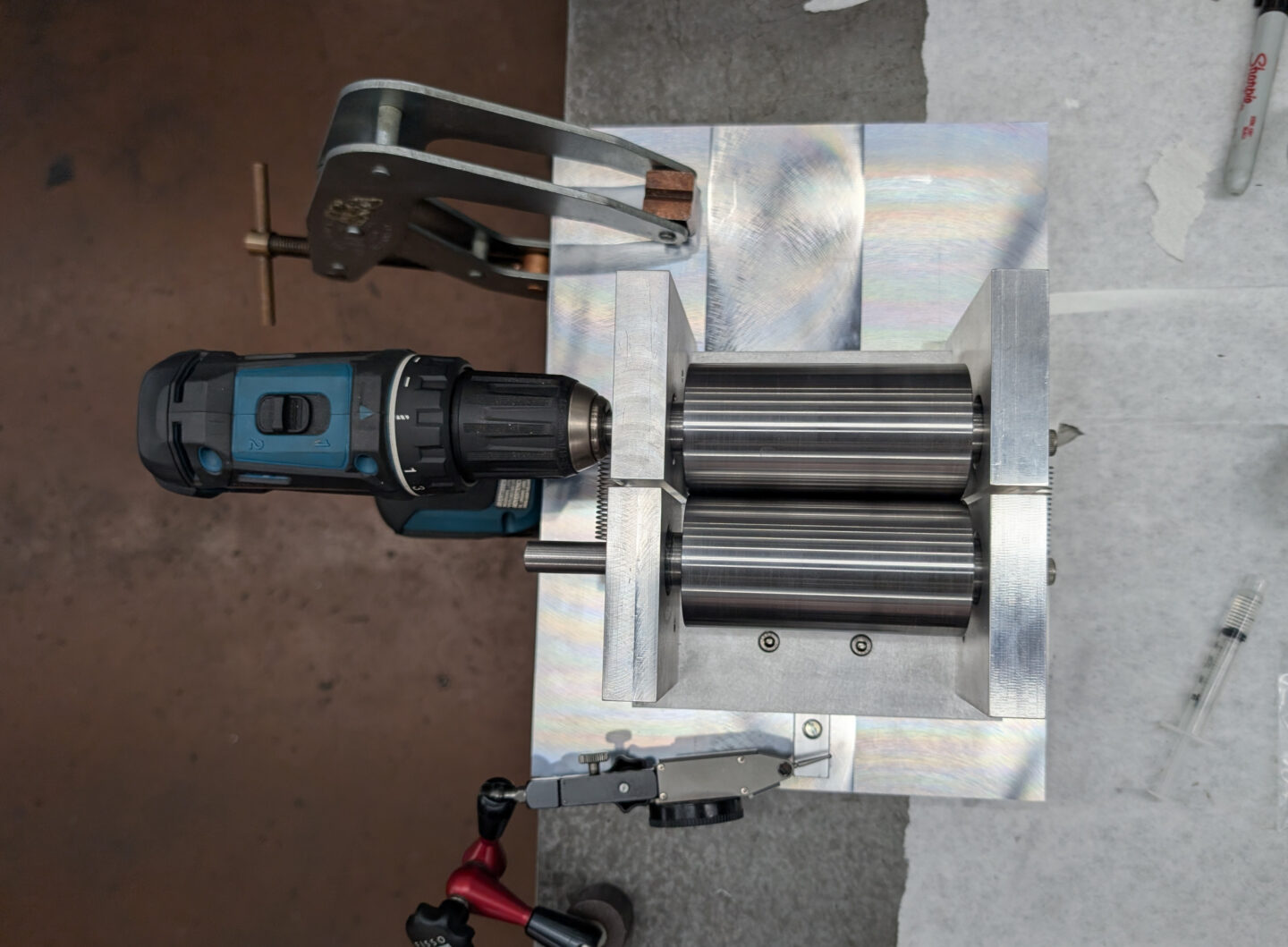
Building a quick prototype allowed the ESPS team to understand how the roller would operate and get a feel for some of the challenges it presented. For instance, the team had a theory that one roller would spin the other if they were touching, but they wanted to make sure this would work when material was passed through the rollers. Testing with the prototype allowed them to confirm that once the rollers were running, there was enough inertia that they would keep spinning when material was fed between them.
“The approach was to make an educated guess, validate that guess with hand calculations, try it, and then iterate based on what we learned from trying it,” explains Takakuwa. “It was the best approach because we could make the device quickly. Many Lab projects we engineer and deliver require a ‘first time right’ approach with thorough analysis before fabrication, which can take significant time and money. This project required turning that approach on its head with a deliverable driven by cost and schedule.”
The ESPS team also knew that the rollers had to be precisely round and parallel to one another to maintain a consistent gap between them with every rotation. A slightly off-centered mounting or small variation in the roundness of the roller caused the gap between the rollers to vary as they spun. They were able to use the prototype to test this gap.
“We were doing things like hunting around for liquids we could put through it or putting strips of paper through it to kind of get a feel for the gaps that were happening,” says Takakuwa. “We wanted to understand, at the actual nip point where the rollers meet, what exactly is happening, and will that be okay for what our goal is?”
They also verified that they were able to reach the necessary speeds with the rollers by measuring them with a tachometer. While they aren’t sure of the exact cooling rate, the material cooled by the device achieves the desired glassy composition that is necessary for Dolpika’s research.
Once Dopilka and Takakuwa were satisfied with the performance of the prototype, they were able to move on to building the final production model of the twin roller quencher. Many of the individual components are off-the-shelf parts, sometimes modified to suit the final purpose. Takakuwa describes the process of finding suitable ready-made parts for a custom project as being a bit like a scavenger hunt, seeing what’s available and then co-opting it for the final purpose. Integration of the parts into the final model was done by the ESPS team.
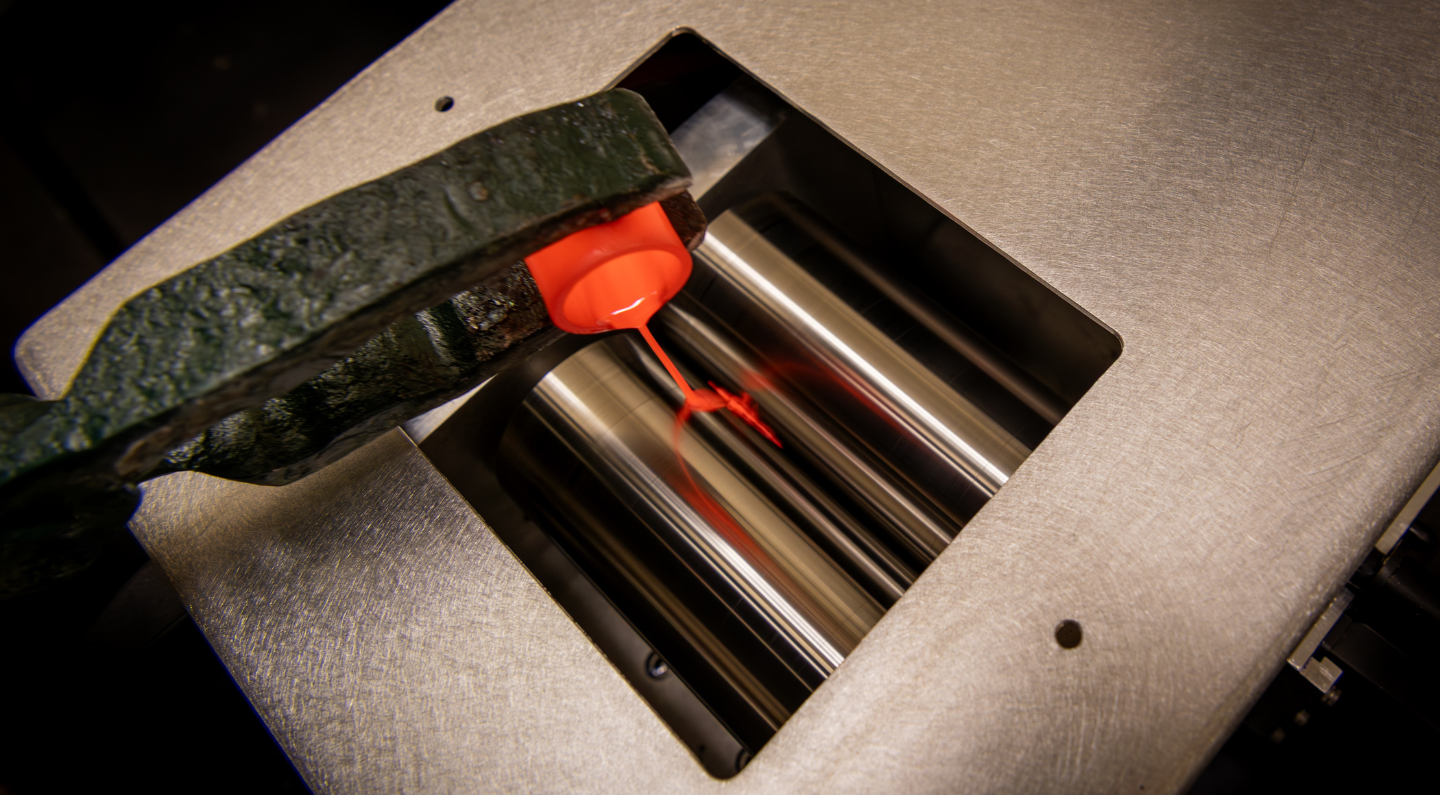
The twin roller quencher is now in Dopilka’s lab, and he is experimenting with the best way to use it, including developing a syringe system to uniformly deliver molten material into the device to encourage the formation of slightly curved, thin flakes of material. These shards are brittle and easy to break up, which is ideal for processing them into powder, the desired end state.
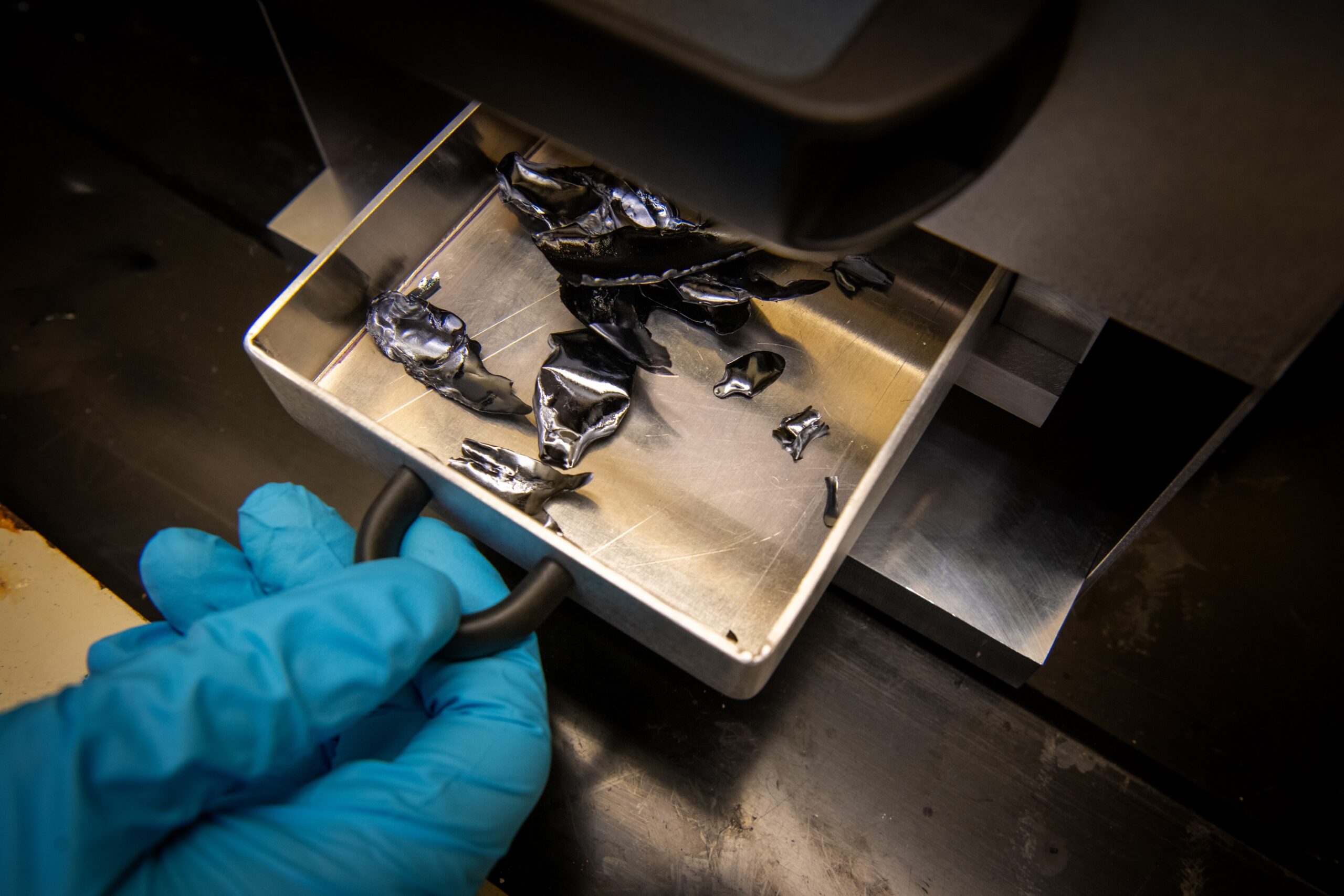
The final product of twin roller quencher: slightly curved flakes of amorphous material that will be ground into a powder. (Credit: Thor Swift, Berkeley Lab)
What is ESPS?
Engineering Small Projects Support is dedicated to making engineering accessible across the Lab by providing cost-efficient, targeted engineering support and resources. The group is dedicated to leveraging the Engineering Division’s capabilities to help partners reach their scientific goals, regardless of project size and complexity.
“Our partner divisions have these needs that are just a little bit beyond what they can do with their in-house staff or at their bench top, or it’s just so much easier for engineering to do the work with our resources,” says Takakuwa. “That’s where ESPS can step in and make a big impact.”