
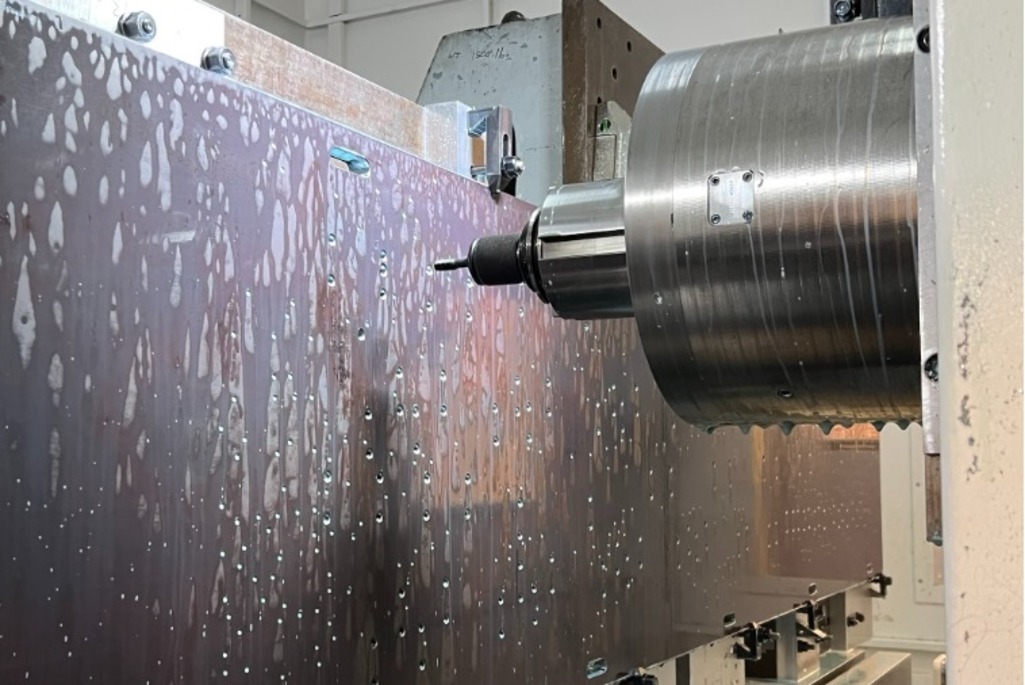
The machine shop’s latest challenge: drilling 771 holes into a large steel plate, ensuring that the position of each hole is accurate to tolerances that are thinner than a sheet of printer paper. This steel plate will serve to mock up several different bases for ALS-U rafts—preassembled, modular segments of accelerator hardware. It will be used to verify the accurate integration of ALS-U vacuum systems and accelerator magnets, though for the purposes of this test dummy magnets will be used. The plate was made on the Lab’s new computer numerical control (CNC) horizontal boring mill, which is able to accommodate the piece’s large size and complete the work more efficiently than other machines in the Engineering Division’s shop.
Laura Wong, ALS-U affiliate mechanical engineer, ALS-U Project Division, Berkeley Lab, explains why a mock-up of the raft is being made: “Instead of working with the actual magnets, which are cumbersome and may not be assembled on the same schedule as the vacuum system, simplified ‘dummy magnets’ with limited features are used.”
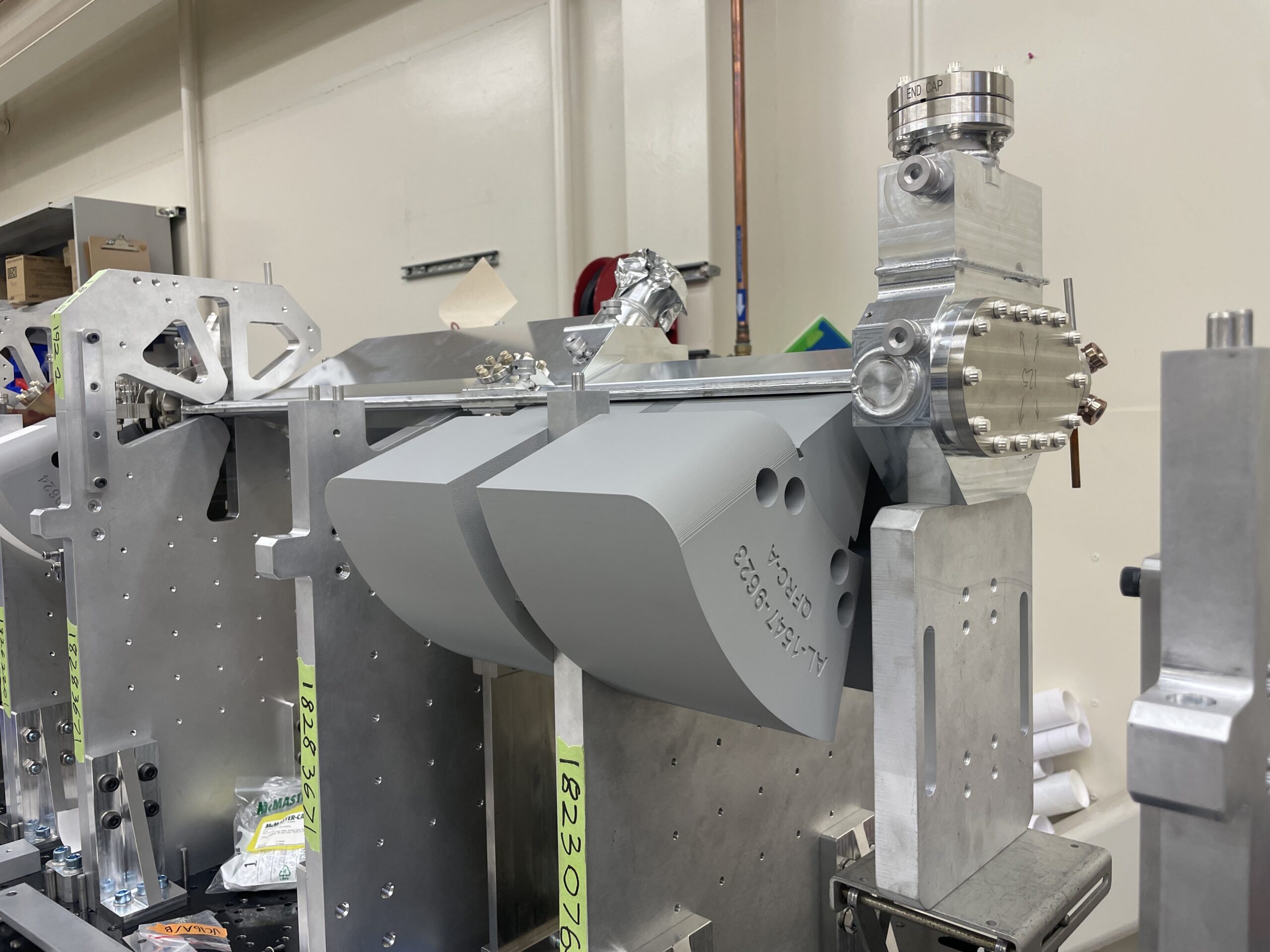
3D-printed ‘dummy magnets,’ used for testing integration with the vacuum system, set up in the Engineering Division’s Vacuum Lab. (Credit: Allison Barker, Berkeley Lab)
The dummy magnets and the vacuum chamber supports are then aligned and bolted to the plate in the same configuration as the actual raft. Test fitting before final installation lets engineers validate assembly processes and complete preassembly steps ahead of time in an area that is less space-restricted than the raft assembly line. This reduces the amount of time engineers must spend performing the final installation of upgraded equipment.
The steel plate measures 1 inch by 25.5 inches by 130 inches and has exactly 771 holes, of which there are four different types: eight-millimeter reamed holes and 10-, 12-, and 16-millimeter tapped holes. Reamed holes have smooth, unthreaded internal walls that allow for extremely tight tolerances. Tapped holes have internally cut screw threads to allow for receiving bolts or threaded fasteners. The holes have tolerances of plus or minus two thousandths of an inch.
One of the main challenges of this project is the size of the plate. The CNC machine has a range of three meters on the horizontal axis. The plate’s size means the machine has to use its full range of motion and still barely reaches the edge, with only a few millimeters to spare. Engineers initially planned to drill only the holes in a central portion of the plate on the CNC machine and drill the left and right sections on a separate machine. However, after analyzing initial plans, machinist Brian Bentley realized that shifting the plate farther left or right along the CNC machine’s mounting table allowed it to reach holes that had initially been deemed outside of its workspace.

The large plate mounted inside the CNC shifted entirely to the left wall of the machine in order for the drill to reach the far right side of the plate. (Credit: Kevin Khoa Wolf, Berkeley Lab)
“In machining, there’s an old adage,” says Bentley. “‘No matter how big your machine, you’ll always need one just a little bit bigger.’ Well, that is still true. Our new machine will need to use every bit of its size to accommodate this part. Even then, I will need to shift the part multiple times to bring all the features into the work envelope.”
The Engineering Division’s new CNC machine is ideal for this work, not only because it is able to accommodate a project of this size but also because it is able to do this work more efficiently. The CNC machine has high-pressure through-spindle coolant and uses special drills that have holes that release coolant at the tip, where the tool generates all its heat. These special drills allow machinists to drill exponentially faster, decreasing the production time from around one minute per hole on the old machine to a mere seven seconds per hole.

The completion of the plate is the result of many collaborators and teams coming together, each tackling their respective process—from the engineers who designed the initial plate schematics to the machinist who drilled all 771 holes into the plate—all in an effort to support ALS-U.
“The raft mock-up is a project under the ALS-U vacuum group in collaboration with people from the ALS-U magnet group, the Survey and Alignment team, and the LBNL machine shop,” explains Wong. “The magnet group provided reasoning behind the design of the magnets when identifying crucial features to include in the dummy magnets. The Survey and Alignment group reviewed the initial design to confirm that nothing would hinder their alignment tools and ability to make adjustments. The machine shop provided guidance on improved design for manufacturability.”
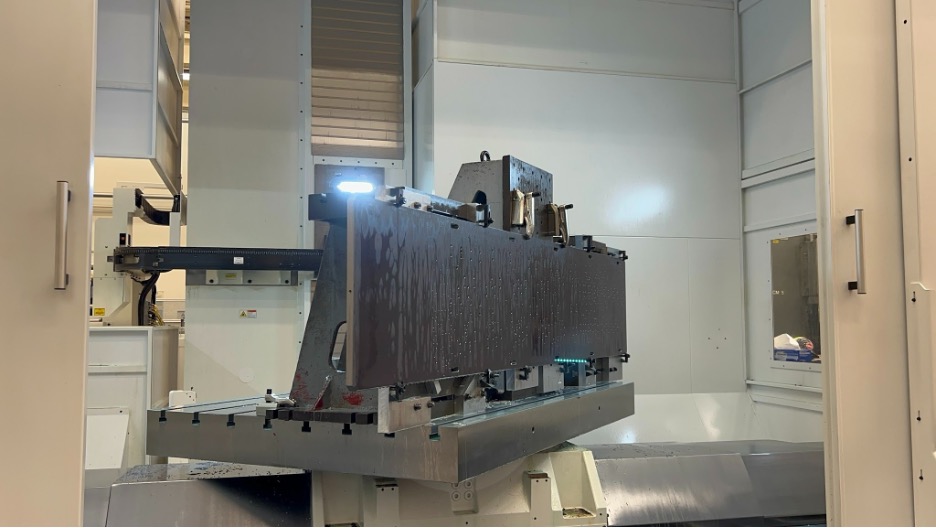
The large plate being rotated inside the CNC machine. (Credit: Kevin Khoa Wolf, Berkeley Lab)
One of the main goals in designing this plate is forward-facing efficiency. Because of the long-term nature of this project, the raft mock-up design has been put in place long before it is actually needed. Designing the plate so that it can be used for multiple assemblies and including extra tooling holes, ensures that any potential design changes, updated timelines, or shifts in assembly can be more easily addressed.
“As final components arrive,” says Wong, “a lot of efforts that began a while ago in preparation for the current validation and integration stages are coming into effect and will continue to streamline the process moving into ramping up raft assembly production for ALS-U.”
Made in Berkeley Lab is a series about the many innovative and groundbreaking items the Engineering Division makes on location, showcasing the highly skilled fabrication and manufacturing expertise at the Lab. From tiny robots and tight tolerances to mammoth detectors, powerful magnets, and new materials, it’s all made right here in Berkeley Lab.
