
Key Takeaways
- The FLPP is a lab space inspection program that identifies and mitigates potential water and leak hazards before they happen, with the goal of reducing costly risk, damage, and disruption.
- The program has inspected 500 spaces, and identified and corrected 200 points of concern.
- Most repairs take less than half an hour to resolve.
Several years ago, a building on the Berkeley Lab campus suffered water damage to the tune of $1 million. A hose that was part of an equipment cooling system failed some time on a Friday evening, just at the start of a long weekend. For the next three days, water flooded the area and trickled down, impacting the space where the leak occurred and lab spaces below. This was a major wake-up call at the Lab: a better system was needed to proactively monitor for water and leak issues and address these problems before they become events that negatively impact operations.
This was the impetus for Berkeley Lab’s Flood and Leak Prevention Program (FLPP), which began as an effort to inspect equipment and infrastructure at the Lab that uses water. The program has evolved into a formalized Lab-wide joint initiative between Operations, the Facilities Division, and the Engineering Division, involving science partners across the Laboratory, with the goal of proactively inspecting research facilities and reducing water-related risk before failures occur.
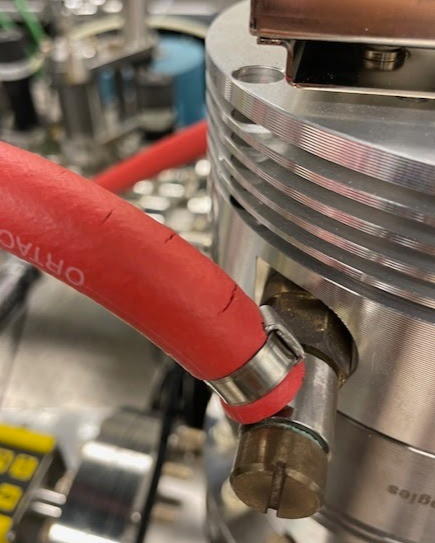
Lab equipment with a cracked water hose – an issue that could lead to leaking or flooding if left unaddressed. (Credit: Joshua Ballesteros, Berkeley Lab)
“An example of when things can go really wrong is in an older-style building,” explains Ben Sandmann, a Strategic Initiatives program manager in the Laboratory’s Operations Division who helped scale up the program. “When you have a leak on one floor and it’s not well contained, there are so many gaps and cracks and things that water just rains down into other floors. Then you end up with a situation where what might have been a small leak in one lab ends up damaging some pretty significant equipment in another lab a couple of floors down.”
The program aims to prevent this scenario by identifying problem hoses, connections, and equipment before they fail, rather than once a leak has already started. To date, over 500 spaces across Berkeley Lab have been inspected as part of the FLPP. Of those, over 250 have been issue-free, and another 200 have had at least one concern identified and actions have been taken to remedy the problem. In total, 12 out of 62 buildings across Berkeley Lab have been completely inspected. In fiscal year 2026 alone, leaks from research equipment have decreased by 83 percent and institutional leaks decreased by 65 percent compared to fiscal year 2025 leak events, demonstrating the power of prevention.
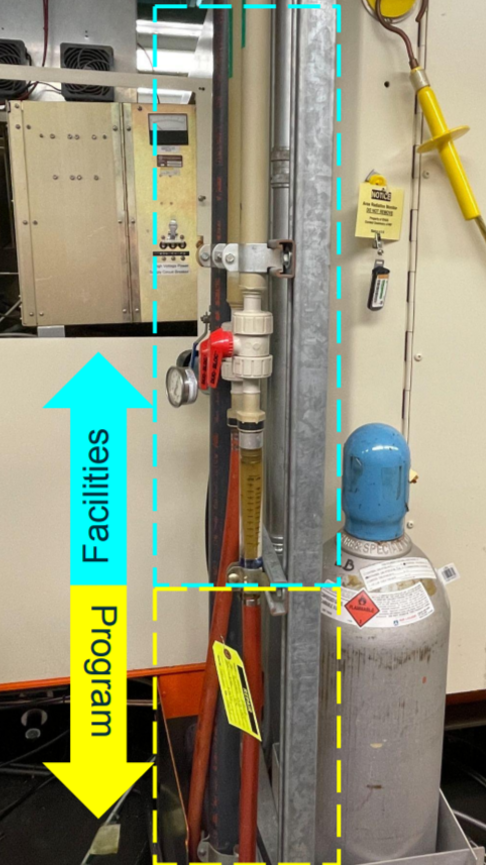
A typical example of water-related infrastructure in a lab space, illustrating the complicated system of ownership present in many facilities at Berkeley Lab.
At a large, complex institution like Berkeley Lab, understanding who is responsible for equipment, buildings, and infrastructure can be difficult to parse, and tackling this problem requires teamwork, buy-in from many different stakeholders, and coordinating already packed schedules. It is not uncommon for responsibility to change hands at connection points or for multiple groups to have responsibility for different components within the same area. The FLPP helps to streamline this for lab owners and science partners, with a single tracking system that the Engineering Division takes ownership of. Once a facility is inspected and issues are identified, they are entered into the tracking system and and the Engineering Division works with the Facilities Division to coordinate repairs.
“This program works because it brings together the people who understand the research with the people who understand the infrastructure that supports it,” explains Joshua Ballesteros, Infrastructure Manager for the Energy Sciences Area and operational and research teams in the Materials Sciences and Chemical Sciences Divisions. “The real value comes from the collaboration. When scientists, engineers, facilities professionals, and building managers work together, we can identify risks early, solve problems before they impact research, and develop solutions that no single group could achieve on its own.”
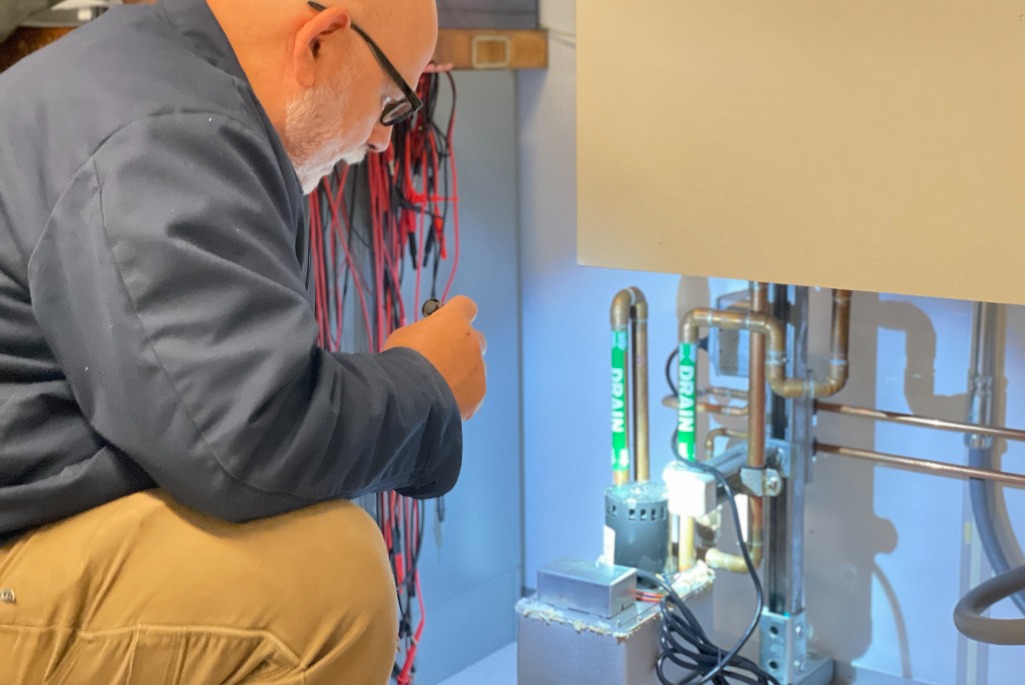
The collaborative nature of this initiative was there from the outset. The initial effort, started in late 2020, was led by Tom Lipton, an Engineering Technical Manager in the Engineering Division, in partnership with Ballesteros. The underlying premise of the initial proof-of-concept effort was to bring the right people and expertise into research spaces to identify potential problems and solutions before they developed into leaks.
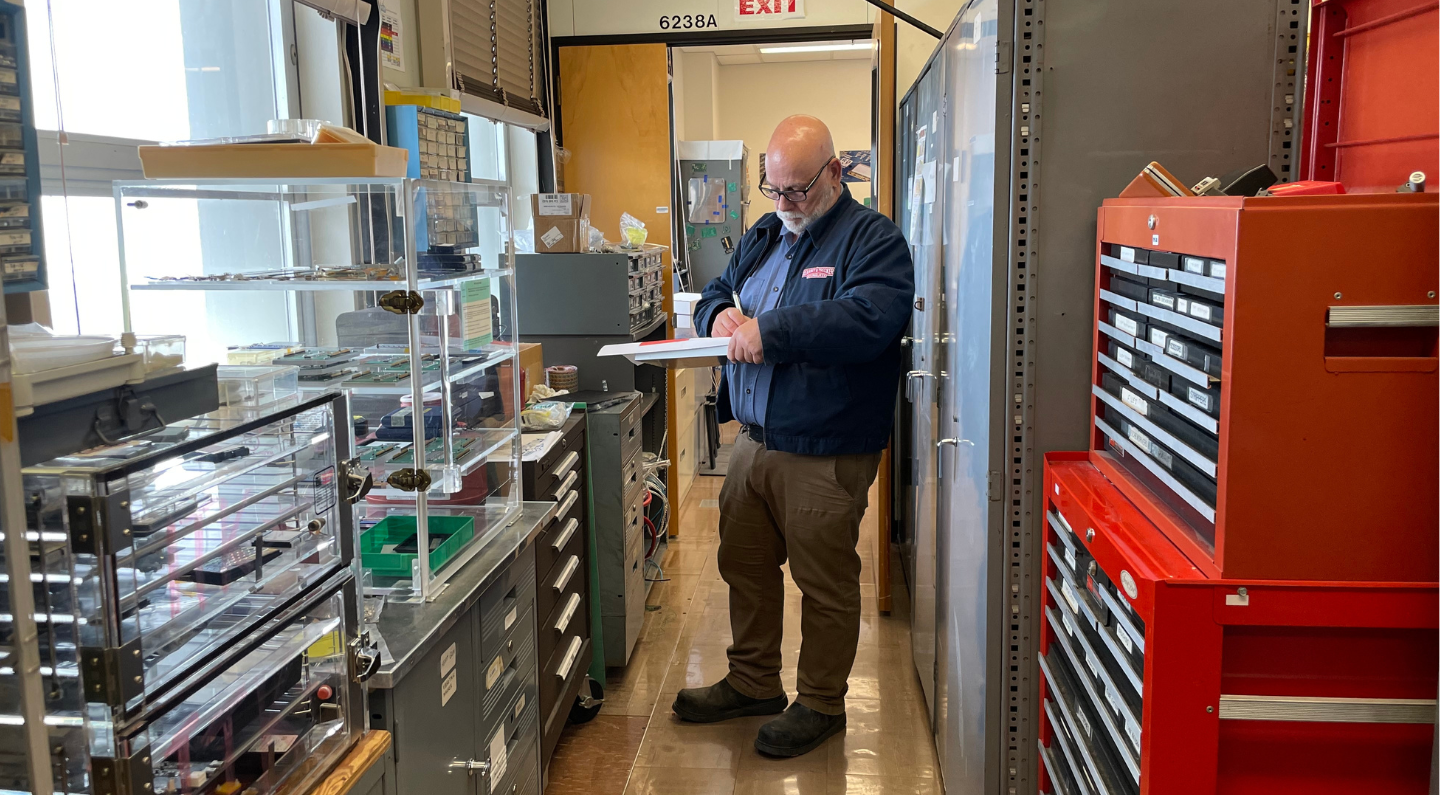
The success of the pilot was driven by cross-functional collaboration and continuous improvement. Energy Sciences Area (ESA) Building Management staff Gracie Hernandez, Didier Perrodin, and Nick Moore helped support and implement a whole-building inspection approach that expanded the effort beyond individual requests. Kristin Camarena, a program manager in ESA, provided dashboarding and data visualization that helped demonstrate program value and support institutional adoption. Rhett Persaud, a program manager in the Operations Division, helped migrate inspection data and workflows from Google Sheets into Jira, establishing a sustainable process for tracking findings, accountability, and continuous improvement.
Today, the program has become a formalized, Lab-wide initiative. Thanks to the support of Lab leadership, the majority of repairs carried out under the purview of the FLPP are simple, taking less than half an hour and minimal budget to mitigate, whereas the alternative to catching these issues can be much more costly and disruptive.
In one memorable instance, Lipton and his team were scheduled to inspect a controlled access Lab on a Tuesday morning.
“On the morning of that Tuesday, a hose burst in that lab and flooded the floors below it,” Lipton says. “We were literally showing up to do the inspection, and Facilities staff were there with mops, and pumps, and fans to dry it all out.”
Lipton emphasizes that the FLPP is in place to protect Berkeley Lab infrastructure and equipment, and keep research operations online.
“Folks can call us anytime, and if they have any concerns, we’ll come right away and inspect their space and make recommendations or corrections,” Lipton says. “You don’t have to get in line, you don’t have to wait until we knock on your door, you can get ahead of the curve, in particular, if you have a lot of equipment that uses water.”
Following Lipton’s retirement at the end of June 2026, Mechanical Engineering Jeff Takakuwa and ALS Mechanical Technology Group Lead Kyle McCombs, will take over Engineering responsibility for this program. Reach out and schedule an inspection in your Lab by contacting the FLPP .
