
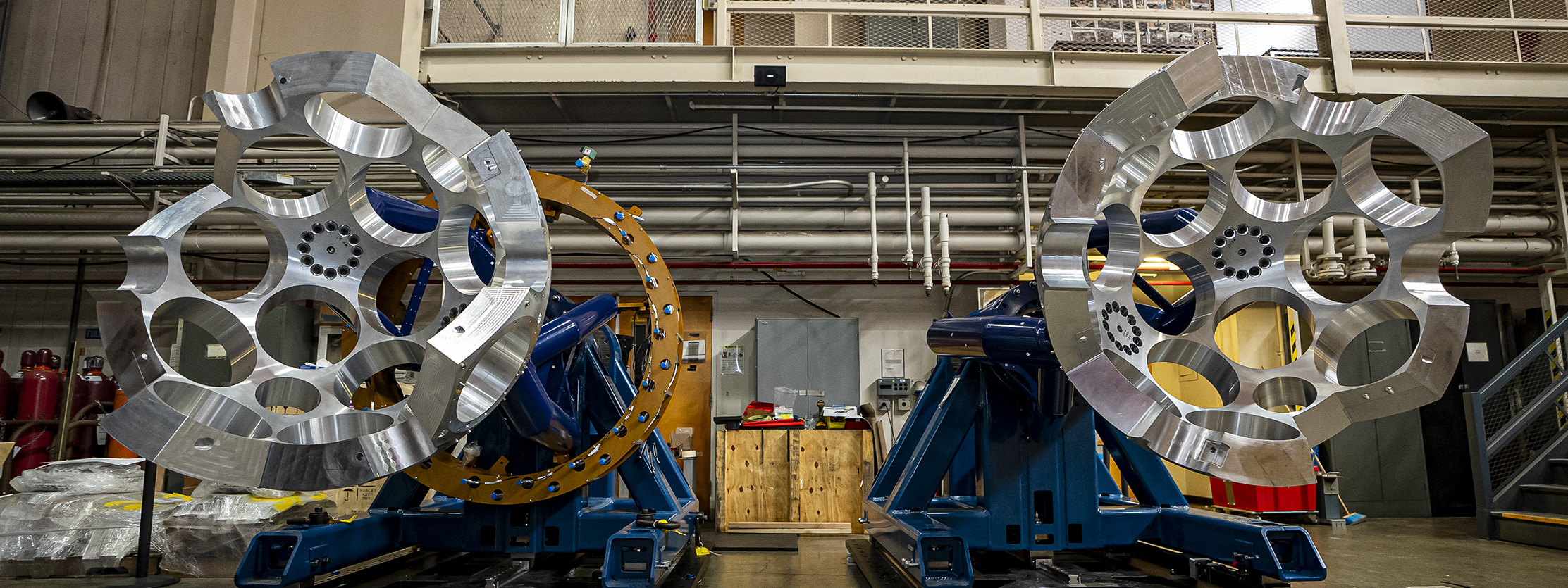
The Mechanical Engineering Department plays a critical role in turning scientific concepts and ideas into tangible reality. Our staff partners with Scientific Divisions at Berkeley Lab to support programs and projects with engineering expertise and rigor. With extensive knowledge of requirements management, design, manufacturing, assembly, commissioning, and operation of complex scientific instrumentation, we excel at delivering innovative solutions for novel and one-of-a-kind applications. Our team is at the forefront of research, designing and building cutting-edge scientific tools and infrastructure that drive discovery and advance science.
Accelerators
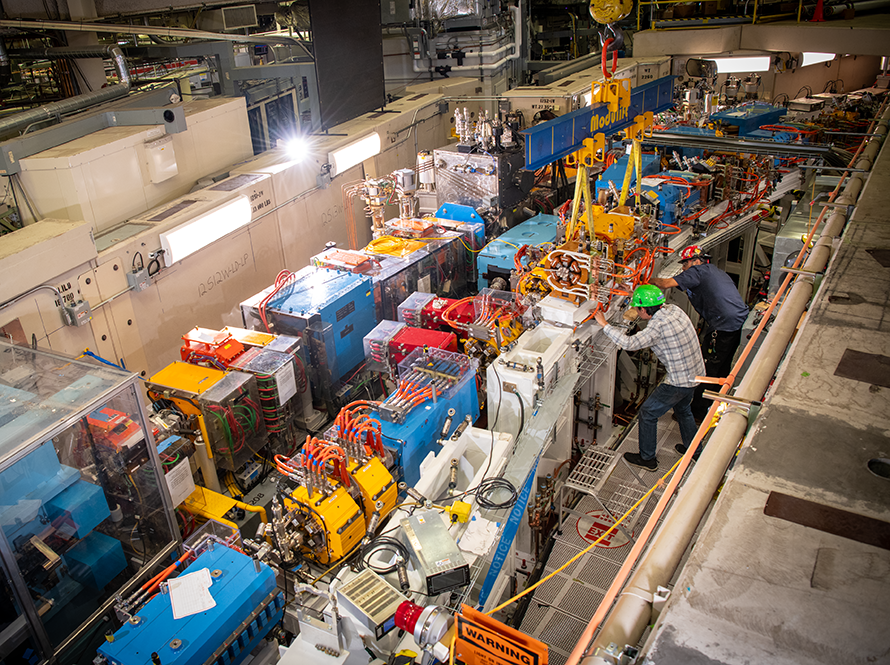
Building particle accelerators has been a core mission of Berkeley Lab since its founding. Modern particle accelerators are complex scientific instruments that require large, multidisciplinary engineering teams for their design and construction. The Division leverages advanced technologies and methodologies to create state-of-the-art particle accelerator designs, and it supports all the phases of the project cycle through production, installation, testing, and commissioning. Mechanical engineering contributes to the development of the core components of accelerators such as the magnets, vacuum and support elements, along with the design of assemblies (called raft modules) within the accelerator, and the overall design integration of the entire accelerator complex.
Beamlines and Undulators
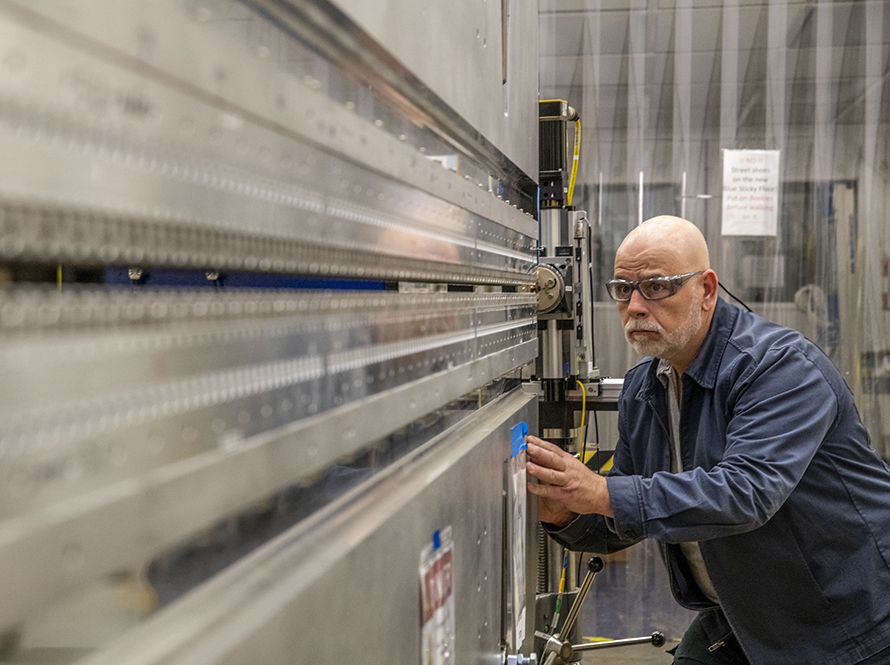
Beamline and undulator engineering is a core competency of the Engineering Division. Developing photon beamlines for light sources requires mechanical engineering expertise in the precision design and alignment of complex assemblies to control photon beam stability, energy, position, and focus. This involves designing ultra-high-vacuum systems, vibration-isolation structures, and high-precision motion stages that operate reliably across a wide range of experiments. Engineering provides expertise in mechanical design, nonlinear finite element analysis, cooling of high-heat-load beamline components (e.g., mirrors), optical ray tracing, and radiation protection. The Division also provides expertise in precision mechanical engineering for designing and building undulators for light sources and free-electron lasers. This is necessary to achieve tight tolerances in magnet alignment and gap control of magnetic structures operating under significant loads.
Detectors and Composites

Detectors measure key scientific phenomena across fields such as particle physics, and X-ray and photon science. They are mechanically intricate, often requiring advanced geometries and the ability to operate in demanding environments. The Engineering Division partners closely with scientists to advance new materials and sensing technologies for detectors, integrating electrical and systems engineering to support effective project planning and execution. Foundational to our expertise in building detectors are the Lab’s composite engineering and fabrication capabilities, which were developed to meet challenges for low-mass, high-stability detector support structures in challenging thermal and radiation environments. This capability is unique within the Department of Energy (DOE) National Lab complex, though the Engineering Division has helped other labs establish their own internal capabilities. Many of the structures that are required to support detectors are at the limits of external vendor capabilities due to their unique requirements. The Engineering Division’s in-house composite fabrication capabilities allow the Lab to facilitate a synergy between project requirements and contiguous R&D for future technology development and to qualify new materials and fabrication techniques that can then be shared with vendors for production.
Large Detectors/Telescopes

Built in unique locations, including underground caverns and mountaintops, large detectors and telescopes are instrumental to our understanding of the nature of matter and the evolution of the cosmos. Engineers in the Large Detectors/Telescopes Group collaborate closely with Berkeley Lab physicists, as well as with science and engineering staff at partnering DOE Laboratories and universities, on the design, fabrication, installation, and commissioning of large detectors—recent and current projects include LZ, DUNE, EOS, and TESSERACT—and telescopes—DESI and SPEC-S5. Technical challenges in this area include cryogenic systems, vacuum systems, low-noise instrumentation, optical design, and fine-motion mechanics. Expertise includes project planning, conceptual development, requirements management, design, manufacturing, testing and integration, commissioning, and operation.
Magnets

Advanced, high-performance magnets play a vital role in many areas of science, and Berkeley Lab Engineering is dedicated to pushing the boundaries of magnet design and technology through research and testing. The department has world-class expertise, and a strong record of collaboration to develop and deliver magnets for light sources, as well as nuclear physics and high-energy physics applications. Our expertise includes undulators, ring magnets, end-station systems, and making associated magnetic measurements, as well as superconducting magnets for ion sources and ion delivery systems. We have a deep understanding and expertise in magnet design and analysis, fabrication, and testing.
Mechanical Design
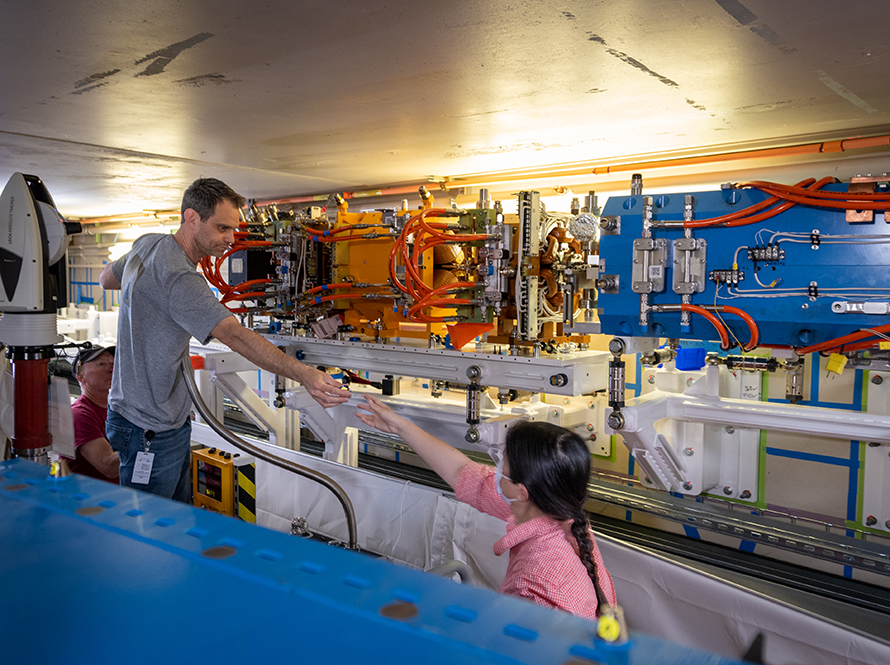
The Mechanical Design group within the Mechanical Engineering Department collaborates with engineers and scientists to develop mechanical 3D Computer-Aided Design (CAD) and the associated 2D drawings used for fabrication and assembly. The design group provides assistance through the entire life cycle of a project, including fabrication and installation, to meet not only the requirements but also the concept of operation. This process includes addressing fabrication (Design-for-Manufacturability, DFM), assembly (Design-for-Assembly, DFA), and maintenance challenges.
Metrology
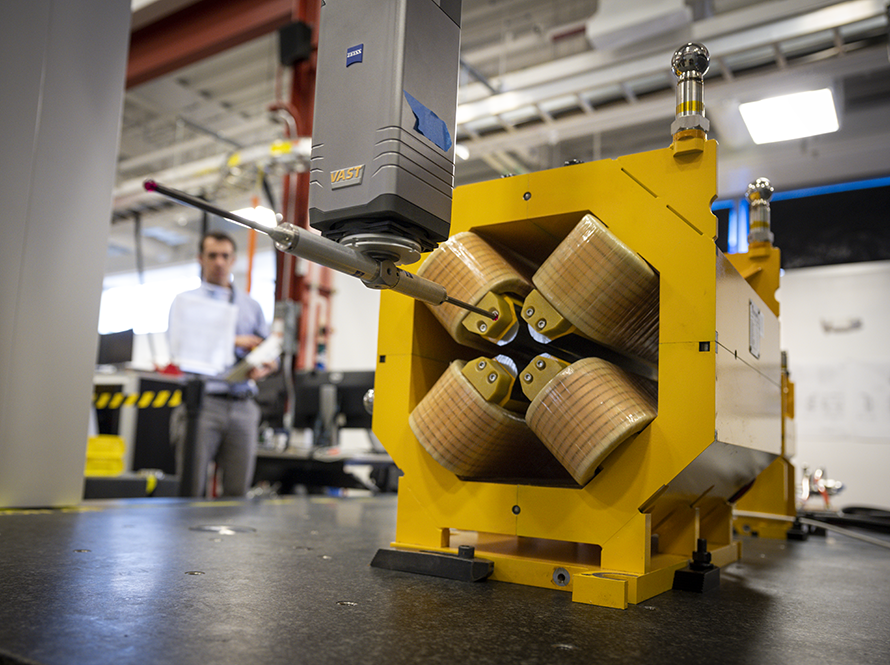
The Metrology Group supports the Engineering Division’s machine shop and projects across Berkeley Lab by verifying parts and assemblies to ensure they meet required specifications. In addition to inspection, the group also provides support for the alignment of complex systems, including the alignment of optical assemblies in the Division’s new cleanroom tent. Our measurement capabilities include two Zeiss coordinate-measuring machines (CMMs), an OPG optical CMM, a Faro portable CMM, displacement interferometers, and a unique magnetic field measurement system. The magnetic field measurement system utilizes a Hall probe sensor that has been integrated into our Zeiss CMM, combining mechanical and magnetic field measurements into a single measurement setup.
Precision (nanoscale) Engineering

Precision mechanisms are highly specialized systems engineered to achieve micron- and nanometer-scale accuracy in motion, alignment, and stability—capabilities that are essential for modern scientific and industrial applications. Our work spans the research, design, fabrication, and metrology of ultra-high-precision components and assemblies. These include X-ray mirror systems, monochromators, precision sample stages, and large-area detector mechanisms used in photon science and materials characterization.
Survey and Alignment

Survey and alignment play a vital role in ensuring the performance of large-scale scientific instruments. At synchrotron facilities such as Berkeley Lab’s Advanced Light Source, equipment needs to be precisely located to within tens of micrometers over the entire 200-meter ring to ensure the quality of the electron beam and the quality of the photon beam on the beamlines. Engineers work on the precise characterization of the “center” of magnets, mirrors, experimental stations, and other accelerator and beamline components, and the precise positioning of those components. The Division employs laser-based measurement systems like interferometers, absolute distance meters, laser trackers, and laser scanners, as well as conventional optical surveying tools, encoder-based touch probes, and coordinate measuring machines. The Survey and Alignment Team’s efforts ensure that electrons and X-Ray beams travel precisely where they should, and experimental results remain consistent over time. The team plays a key role in the reliability, functionality, and safety of large research instruments and accelerator systems.
Systems Engineering
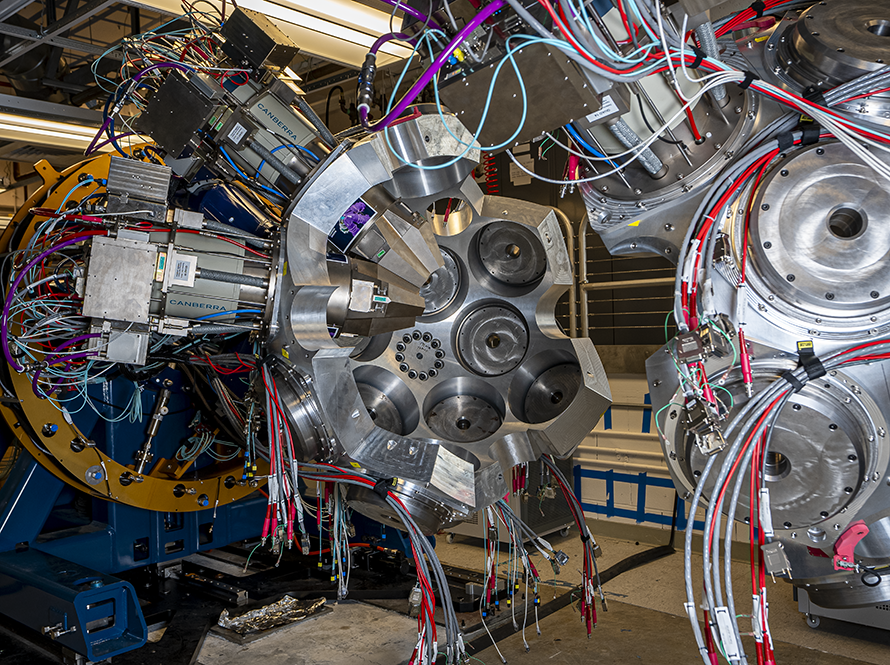
Berkeley Lab’s Systems Engineering group partners with science, engineering, and project management teams across the Laboratory from project concept through commissioning, turning science goals and performance targets into verifiable requirements and clear technical baselines. Throughout the project life cycle, we manage requirements, interfaces, performance budgets, and configuration management to ensure seamless integration. We align with DOE project management practices, enabling the delivery of the Laboratory’s most ambitious projects—from large accelerator facilities to miniature detector assemblies. Our disciplined approach yields systems that are safe, reliable, maintainable, and ready to accelerate scientific discovery.
Berkeley Lab’s Engineering Division is a unique collection of engineering, technical, and scientific talent. Our workforce brings together expertise across a range of disciplines to bring cutting-edge science to life.

The Division collaborates with researchers to enable groundbreaking science, designing and building the detectors that enable cutting-edge physics experiments, and pushing accelerator and beamline engineering frontiers. Capabilities include accelerator engineering, detector systems and custom electronics, fabrication and manufacturing, and project execution.
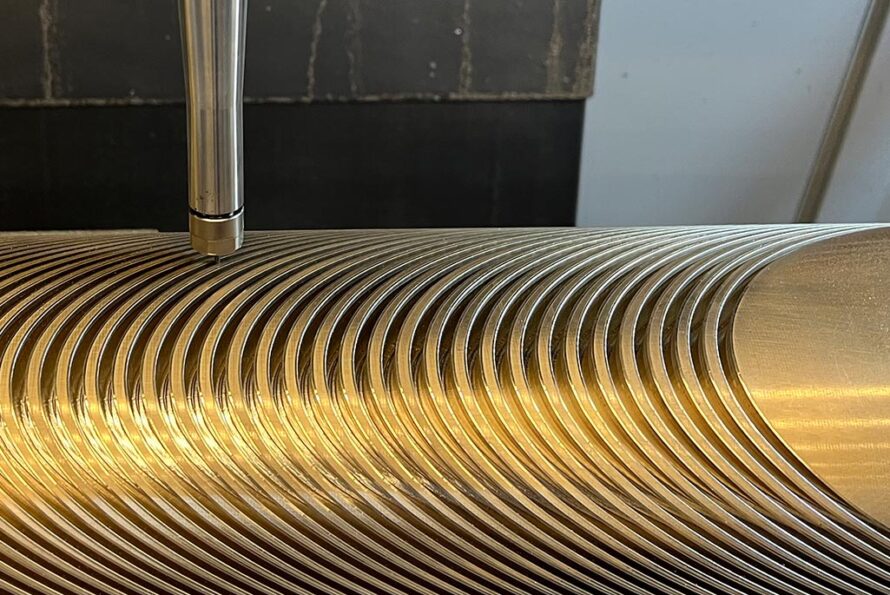
Made in Berkeley Lab: elegant arcs for superconducting magnets
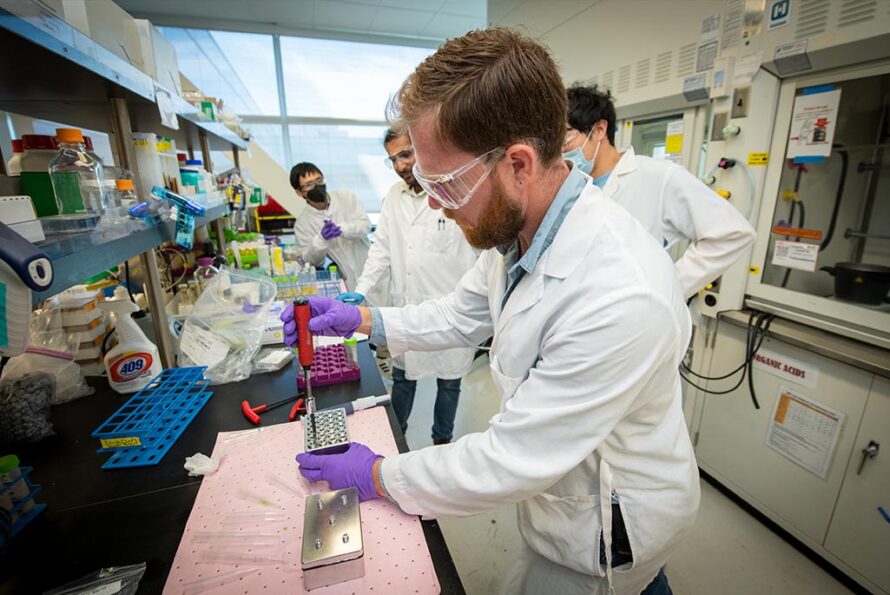
New small-batch chemical reactor design provides a springboard for science
Senajith “Seno” Rekawa awarded ASPE 2025 Distinguished Service Award